


The Intelligent Network: An Overview of the Modern Ai In Telecommunication Industry
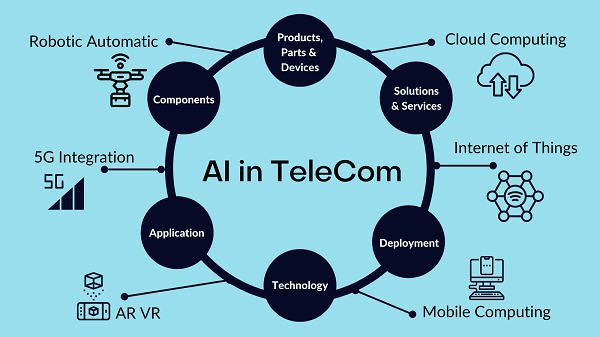
The global telecommunications sector, the foundational infrastructure of our digital world, is undergoing its most profound transformation in decades, driven by the powerful integration of artificial intelligence. The modern Ai In Telecommunication industry is a rapidly expanding ecosystem focused on embedding machine learning, natural language processing, and advanced analytics into every facet of a telecom operator's business. This is not about a single application but a fundamental shift in how networks are managed, customers are served, and new services are created. AI is being used to automate complex network operations, predict equipment failures before they happen, optimize radio signal quality in real-time, personalize customer interactions, and detect fraudulent activity with unprecedented accuracy. As telecommunication networks become exponentially more complex with the rollout of 5G, the proliferation of IoT devices, and the demand for ultra-low latency services, human-led management is no longer viable. AI has become the indispensable "brain" required to orchestrate this complexity, ensuring network reliability, improving operational efficiency, and unlocking new avenues for growth and innovation.
The primary application and initial driver for AI adoption within the telecommunications industry has been in network operations and management. Traditional network management relies on static rules and manual intervention by engineers to handle issues like network congestion, equipment faults, and performance degradation. AI completely revolutionizes this paradigm. For instance, predictive maintenance models analyze historical and real-time data from network equipment (like cell towers and routers) to identify subtle patterns that precede a failure. This allows operators to dispatch a technician to fix a component before it breaks, preventing service outages and moving from a costly, reactive "break-fix" model to a proactive, preventative one. Similarly, AI-powered network optimization engines continuously analyze traffic patterns, signal interference, and user distribution to automatically adjust network parameters in real-time. This self-optimizing capability ensures that network resources are used with maximum efficiency, improving call quality, boosting data speeds, and delivering a superior customer experience without constant human oversight.
Beyond the network core, AI is also transforming the customer-facing side of the telecommunications business. Customer service and experience have become key battlegrounds for retaining subscribers in a highly competitive market. AI-powered chatbots and virtual assistants are now the first line of support, capable of handling a vast range of common customer queries—such as billing inquiries, service plan changes, and basic troubleshooting—24/7 and in multiple languages. This frees up human agents to handle more complex and high-value interactions. Furthermore, machine learning models are being used for churn prediction. By analyzing a customer's usage patterns, service history, and interaction data, these models can identify subscribers who are at high risk of switching to a competitor. This allows the telecom operator to proactively reach out with targeted retention offers, personalized discounts, or service improvements, significantly reducing customer churn and protecting valuable revenue streams, a critical function in a subscription-based industry.
The ecosystem of the AI in telecommunication industry is a symbiotic relationship between several key players. The telecommunication operators (telcos) themselves are the primary consumers and deployers of the technology. The traditional network equipment providers (NEPs) like Ericsson, Nokia, and Huawei are increasingly embedding AI and ML capabilities directly into their hardware and network management software, offering "AI-native" solutions. The major cloud hyperscalers—Amazon Web Services (AWS), Microsoft Azure, and Google Cloud—are playing a pivotal role by providing the scalable cloud infrastructure, powerful AI/ML platforms, and pre-built AI services that telcos need to develop and deploy their own custom AI applications. Finally, a vibrant ecosystem of specialized AI software vendors is providing best-of-breed solutions for specific problems, such as fraud detection, customer journey analytics, or advanced network assurance. This collaboration between telcos, equipment vendors, cloud providers, and software specialists is what drives innovation and accelerates the adoption of AI across the entire industry.
Explore More Like This in Our Regional Reports:
